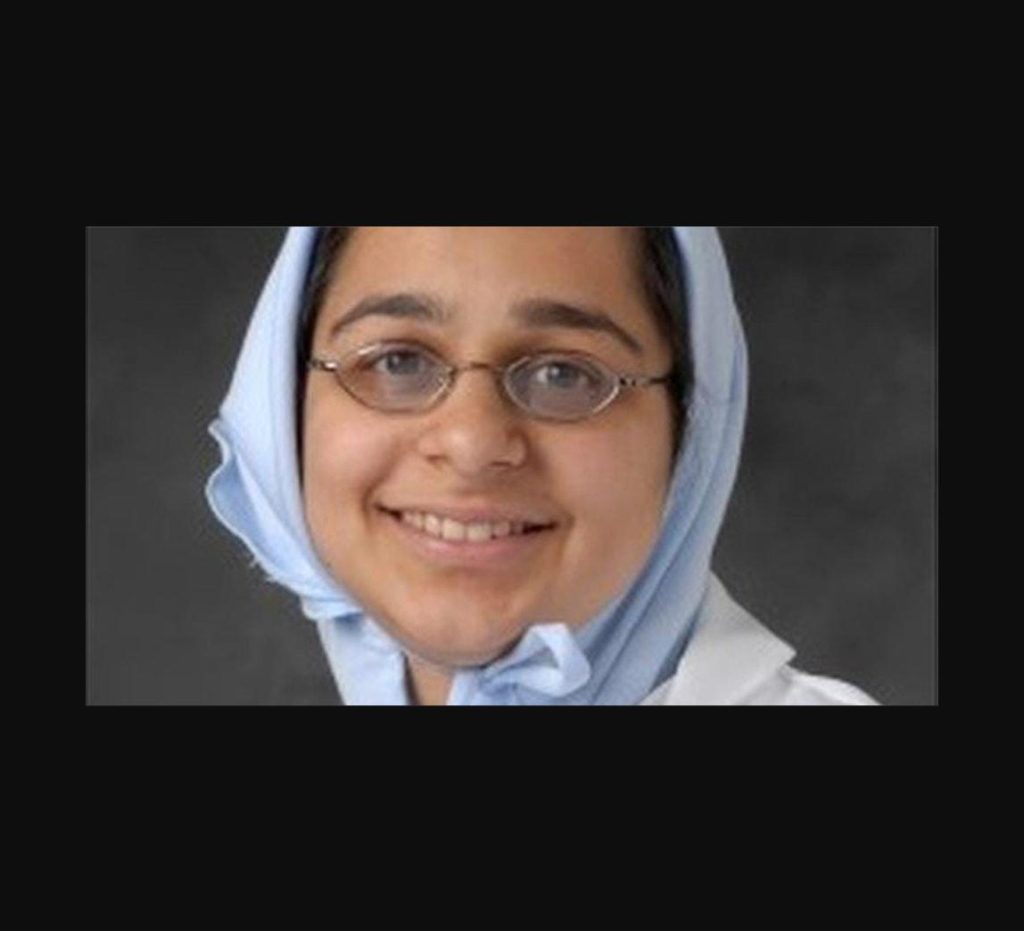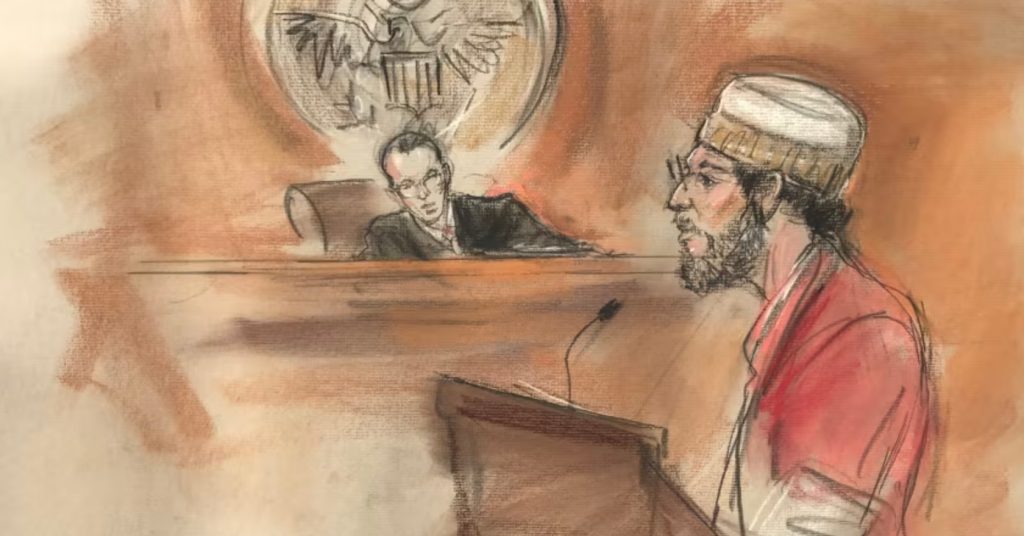
Michigan’s attorney general requested closing the licensing investigation into an FGM clinic owner four months before the federal case against him was dismissed.
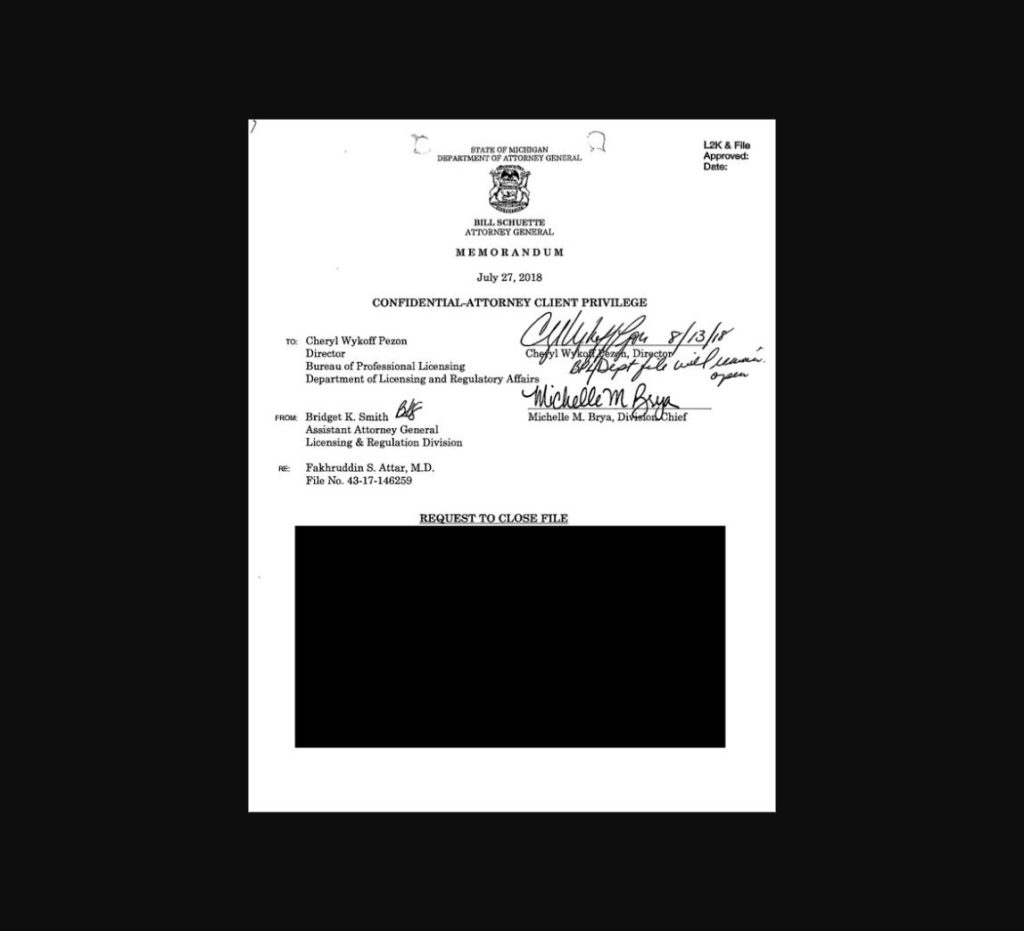
On July 27, 2018, Michigan’s Assistant Attorney General Bridget K. Smith recommended closing the state’s licensing investigation into Dr. Fakhruddin Attar, the owner of the clinic at the center of America’s first federal FGM prosecution. The federal FGM charges were not dismissed until November 20, 2018, four months later.
Smith sent her recommendation in a memo titled “Request to Close File” addressed to Cheryl Wykoff Pezon, then Director of the Bureau of Professional Licensing at LARA. LARA received the memo on August 7, 2018, as recorded by a received stamp on the document.
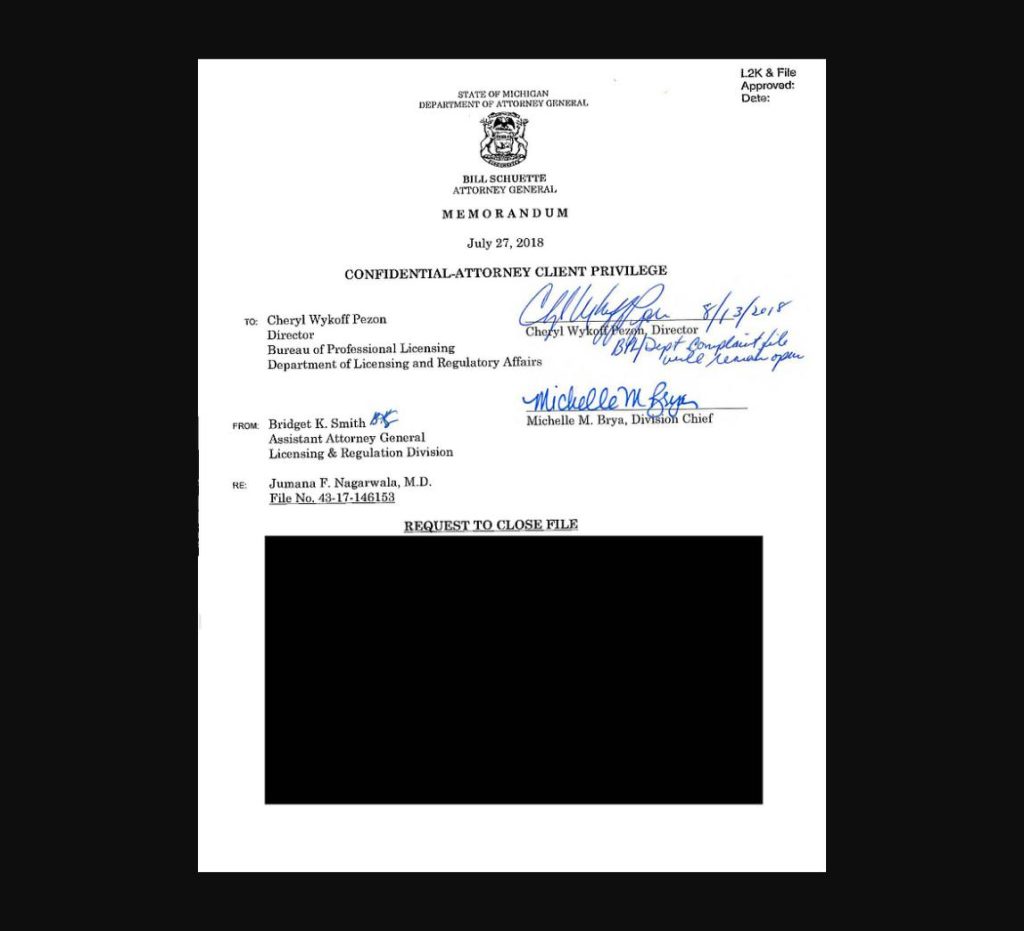
Like the closure memo for Dr. Nagarwala, the physician accused of performing the procedures at Attar’s clinic, the substantive content of the Attar memo is redacted in full. The state has never explained why it closed either investigation.
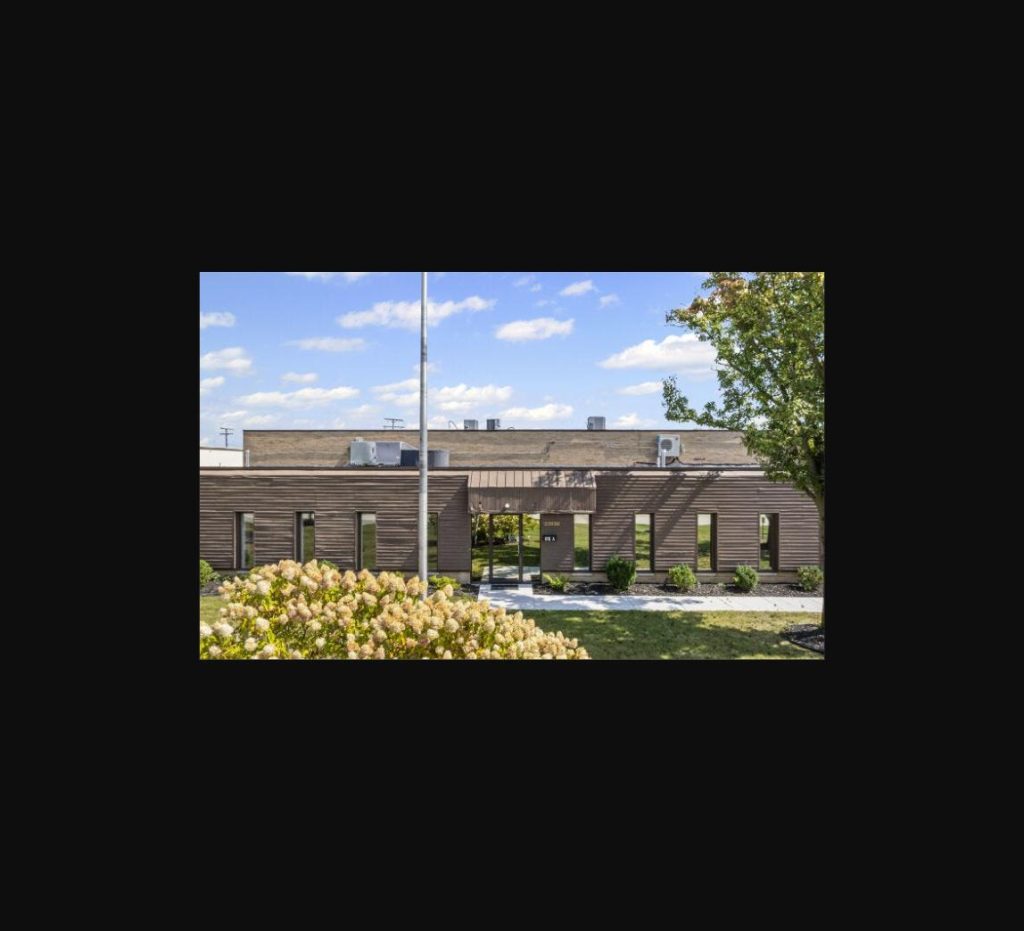
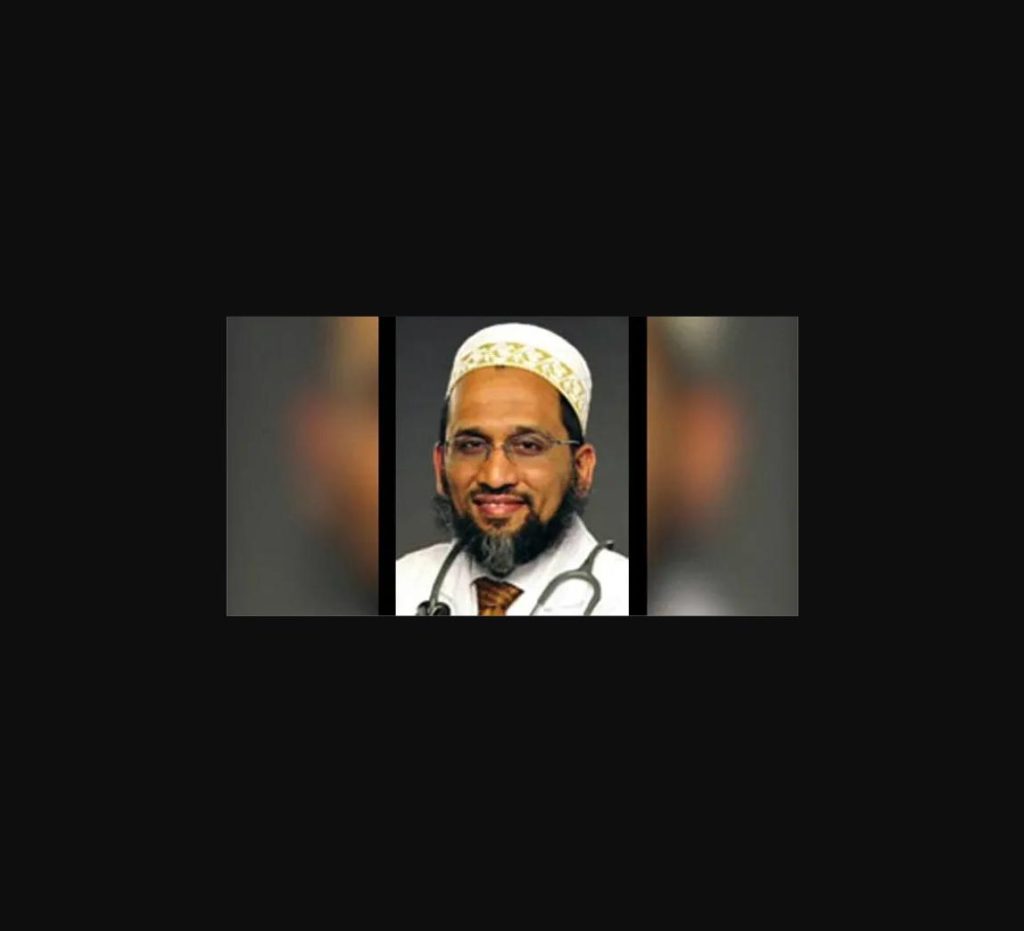
As I have previously reported, Dr. Attar still holds an active, unrestricted Michigan medical license (No. 4301067384) with no record of discipline. Federal prosecutors alleged that Attar allowed Dr. Jumana Nagarwala to perform FGM on young girls at his Livonia clinic after hours for over a decade, with his wife Farida assisting during the procedures. Prosecutors estimated that as many as 100 girls may have been cut at the clinic over a twelve-year period. His clinic has since reopened at a new location in Farmington Hills and is accepting new patients, including children.
Michigan’s Board of Medicine unanimously authorized the investigation into Dr. Attar on April 21, 2017. Board reviewer Dr. Peter Graham wrote: “I approve investigation. Please also refer to Director Gaedeke for summary suspension, which I approve.” Board reviewer Dr. James Sondheimer, a professor of medicine at Wayne State University, wrote: “Agree with proceeding with investigation. Res ipsa loquitur,” a legal term meaning “the facts speak for themselves.”
Despite the Board’s authorization, no disciplinary action was taken. The only document that would explain this decision, the closure memo from AAG Smith, is redacted in full.
The document closing the case is entirely redacted.
Documents obtained from the Attorney General’s office show that Smith authored both the Attar and Nagarwala closure memos on the same date, July 27, 2018, and sent them to the same recipient. A response from LARA’s Cynthia Rowe to Smith, dated August 14, 2018, is also withheld under attorney-client privilege.
Both closure memos were sent while the federal case was still active. Trial had been scheduled for January 2019. The state did not wait for the federal case to conclude. As we reported previously, Michigan closed the Nagarwala investigation on September 25, 2018, two months before the federal dismissal. The AG recommended closing the Attar investigation even earlier, on July 27, four months before the federal case ended.
Due to Bridget K. Smith’s recommendation and the Michigan Department of Licensing and Regulatory Affairs’ acceptance of it, the doctor who owned a clinic prosecuted for FGM still holds his medical license and would have retained it even if convicted.
Those involved have hidden their reason for protecting FGM doctors’ medical licenses from the public.
The Michigan Department of Licensing and Regulatory Affairs and the Michigan Attorney General’s office did not respond to requests for comment.
The state investigation into an FGM doctor’s medical license ended before the federal case. Their memo closing the case is entirely redacted.
Michigan closed its licensing investigation into Dr. Jumana Nagarwala, the physician at the center of America’s first federal FGM prosecution, on September 25, 2018, two months before the federal court dismissed charges against her on November 20, 2018.
This means that an FGM doctor retaining her medical license had nothing to do with losing the federal case. The investigation into the medical license ended while the federal case was still set to go to trial.
State licensing records obtained through the Freedom of Information Act show that the only licensing investigation Michigan ever opened into Dr. Nagarwala was closed with the disposition “No Action Taken.” The closure date of September 25, 2018 is recorded in a LICENSE 2000 COMPLAINT HISTORY printout from Michigan’s Department of Licensing and Regulatory Affairs (complaint file 43-XX-146153).
The closure was initiated by Assistant Attorney General Bridget K. Smith of the AG’s Licensing and Regulation Division. On July 27, 2018, Smith sent a memo titled “Request to Close File” to Cheryl Wykoff Pezon, then Director of the Bureau of Professional Licensing at LARA. The memo’s content is redacted in full.
Documents explaining the closure are entirely redacted.
Neither Michigan’s Department of Licensing and Regulatory Affairs nor the Michigan Attorney General’s office has disclosed why they recommended closing the investigation. Both agencies have withheld the memo under attorney-client privilege.
As I previously reported, Michigan never held administrative hearings on Dr. Nagarwala’s license. Dr. Nagarwala still holds an active, unrestricted Michigan medical license (No. 4301071795) with no record of discipline. She was federally charged in April 2017 with performing female genital mutilation on young girls in what prosecutors called the first federal FGM case in U.S. history. The federal charges were dismissed in November 2018 after a judge ruled the 1996 federal FGM ban was unconstitutional. No party in the case disputed that procedures were performed on the girls.
Michigan’s Board of Medicine unanimously authorized the investigation on April 18, 2017, days after the federal indictment. Multiple reviewers signed Board Review Sheets directing the Bureau of Professional Licensing to investigate under MCL 333.16231(2). One reviewer wrote that the charges “warrant suspension and investigation.”
Despite the Board’s authorization, the investigation produced no disciplinary action. The only document that would explain why, the closure memo authored by AAG Bridget K. Smith, is redacted in full.
If Michigan had closed its investigation after the federal case collapsed, the state could argue it was deferring to federal proceedings and lost its basis for action when the charges were dismissed. But Michigan closed first. The state abandoned its own investigation while the federal case was still active.
At the time the medical licensing case was closed, the government had just obtained a Third Superseding Indictment thirteen days earlier, defendants had not yet been arraigned on it, and trial remained on the court’s calendar.
Documents obtained from the Michigan Attorney General’s office confirm that both the AG and LARA hold copies of the closure memo, and both refuse to release it. The AG’s privilege log identifies it as Document 72: “Request to Close File,” July 27, 2018, from AAG Bridget Smith to Cheryl Pezon. A draft version is listed as Document 78, also withheld. LARA has separately confirmed that “no other closure letter exists” beyond this memo.
Michigan closed an investigation into female genital cutting on children while those responsible were still being prosecuted and will not explain why.
The Michigan Department of Licensing and Regulatory Affairs and the Michigan Attorney General’s office did not respond to requests for comment.
Next week, I will be publishing more on the FGM-licensing investigation.
To recap: In previous articles, I discovered that the two doctors at the center of the first federal FGM-case still have their medicallicenses, their clinic open, and were never even subjected to hearings.
My last article was three months ago. During that time, I have been filing freedom of information act requests and investigating. Though there were a dozen different articles I could write, publishing them early might have jeopardized other information I was seeking and would have raised questions I still didn’t have the answers to. I chose to delay publication of a partial story in the hopes that later I would be able to publish a more complete story.
To give you an idea what the process of getting this information has been like, here are the actual notices I received for one set of documents. I filed the request on January 11, 2026. On February 2, they told me it would cost $783.85 total for the documents. I paid one day later, on February 3, 2026. Then:
February 2, 2026 — “After receipt of the deposit or full payment, the Department will commence processing the request. The Department will complete the process within an estimated 21 business days.”
March 5, 2026 — “The Department requires up to 21 more business days, through April 3, 2026, to complete the processing of the request.”
April 3, 2026 — “The Department requires up to 15 more business days, through April 24, 2026, to complete the processing.”
April 24, 2026 — “The Department requires up to five more business days, through May 1, 2026, to complete the processing.”
So I paid in one day. They took three months. That was just one request.
Documents received are frequently and inconsistently redacted. I have been appealing most decisions. They have rejected all appeals, including the $12,792.93 fee they wanted to search “FGM” and other terms in across their emails.
That said, I have found ways to uncover the information required to piece together a picture of what happened and why the two doctors who were federally charged with FGM still have their medical licenses.
Because of the amount of information I have collected, it will take multiple articles to share it all. Rather than publish one unreadable book-long story, I’ll be sharing it headline by headline over the coming weeks.
Thank you for those who have supported my investigation. We raised enough to cover expenses. That said, if I want to file legal challenges or take further action, we will need more. You can support my work on GoFundMe here.
P.S. I am launching a new substack for fiction, essays, and video. The fantasy novel I have been working on nearly three years will be previewed there. Since the audience for my fiction work and journalism are different, I’m keeping them separate under separate accounts. However, if you’d like to read my fiction work, subscribe here. There will be no talk of social issues there, but a lot of entertaining stories.
The clinic where federal prosecutors say up to 100 girls had female genital cutting performed on them is still open at a new location under a nearly identical name. It is run by the same doctor, has the same phone number, and is currently accepting new patients.
In April 2017, Burhani Medical Clinic in Livonia, Michigan was raided by the FBI as a part of the first federal prosecution of female genital mutilation in United States history.1 Federal prosecutors alleged that Dr. Jumana Nagarwala had performed FGM on young girls at the clinic after hours, with the clinic’s owner, Dr. Fakhruddin Attar, allowing her to use the facility and his wife, Farida Attar, assisting during procedures.2 Prosecutors estimated that as many as 100 girls may have been cut at the clinic over a 12-year period.3
As we previously reported, both Dr. Nagarwala and Dr. Attar still hold active, unrestricted Michigan medical licenses with no public record of discipline.4 5 In addition to allowing both doctors to continue practicing medicine, the state of Michigan has allowed the clinic itself to reopen at a new location under a nearly identical name, where it is currently accepting new patients.6
Screenshot from the website for Burhani Medical Center
Dr. Attar now operates a medical practice called Burhani Medical Center at 32910 W 13 Mile Road in Farmington Hills, Michigan.7 The practice uses the same phone number as the former Livonia clinic, (734) 427-9200, and is listed across major healthcare directories including Healthgrades,8WebMD,9 and the U.S. News doctor database.10 Dr. Attar’s website, doctorattar.com, promotes the Burhani Medical Center as a family medicine practice and states that it is accepting new patients.11
The Burhani Medical Center website lists Sports Physicals among its services and promotes care for patients of “every age group.”12 The practice displays logos indicating it accepts Medicare, Medicaid, and major commercial insurers including Blue Cross Blue Shield, Aetna, and United Healthcare.13 This means a physician federally charged with facilitating genital cutting on minor girls is actively marketing pediatric services and receiving reimbursement from taxpayer-funded insurance programs.
Screenshot from the website for Burhani Medical CenterScreenshot from the website for Burhani Medical Center
Public records show a link between the two practices. Michigan LARA corporate filings show that Attar, M.D., P.C., the professional corporation that operated under the assumed name “Burhani Medical Clinic” at the Livonia address, was dissolved in May 2021.14 This dissolution came shortly before the final remaining charges against the Attars were dismissed in September 2021.15
The original Burhani Medical Clinic in Livonia was not a licensed health facility under Michigan law. In Michigan, private physician offices are exempt from the state facility licensing that applies to hospitals, surgical centers, and nursing homes.16 This means there was no facility license to revoke, no facility-level inspection triggered by the federal charges, and no regulatory mechanism to prevent the same practice from reopening at a new address under a nearly identical name. The only regulatory oversight over the practice ran through the individual physicians’ medical licenses. As we have previously reported, both physicians’ medical licenses are active, unrestricted Michigan medical licenses with no public record of discipline.
When I called the clinic on February 5, 2026, a staff member answered the phone and confirmed the practice is open. Dr. Attar did not respond to multiple requests for comment.
16 Michigan Department of Licensing and Regulatory Affairs. “Licensing Health Facilities and Agencies Administrative Rules, R 325.45101 to R 325.45385.” Michigan Administrative Code, R 325.45103(t), eff. 1 Apr. 2024, ars.apps.lara.state.mi.us/AdminCode/DownloadAdminCodeFile. Accessed 4 Feb. 2026.
The second doctor from America’s first FGM case, Dr. Fakhruddin Attar, still has an active unrestricted Michigan medical license (No. 4301067384).1
Dr. Fakhruddin Attar ran his clinic in Livonia, Michigan raided by FBI in April 2017 in what would become the first federal prosecution of female genital mutilation in United States history.2 According to federal prosecutors, Attar had been allowing Dr. Jumana Nagarwala to perform FGM on young girls for over a decade, with his wife Farida assisting in the examination room.3
As I reported in January, the doctor who performed FGM, Dr. Nagarwala, still holds an active Michigan medical license (No. 4301071795) with no record of discipline.4 5 The second doctor charged in America’s first FGM case, Dr. Fakhruddin Attar, also has an active unrestricted Michigan medical license (No. 4301067384) with no record of discipline.6
Although the federal case against both Dr. Attar and Dr. Nagarwala collapsed on legal technicalities, state medical boards could still remove both doctors’ medical licenses. Doctors can lose their licenses for inadequate recordkeeping, failing to complete continuing education hours, billing errors, breaches of patient confidentiality, and non-criminal behavior far less severe than performing FGM on minors. Instead, the Michigan medical board allowed both doctors to keep their medical licenses with no restrictions or discipline.
To understand what that means, consider what federal court documents say happened at Dr. Attar’s clinic:
Federal prosecutors allege that Dr. Fakhruddin Attar’s conspiracy ran from 2005 to 2017 and may have involved as many as 100 victims.7 8
The FBI’s investigation identified nine victims between the ages of 7 and 13 from Michigan, Minnesota, and Illinois.9 When the FBI interviewed those girls, one said she’d been told they were going to the doctor because “our tummies hurt.” She described being placed on an examining table with her knees near her chest and her legs spread apart. She said the doctor “pinched” her on the place where she “goes pee,” and she was given a pad to wear in her underwear. She was told not to talk about it.10
The second girl said she “got a shot” and that it hurt so badly she screamed. She drew an “X” on her picture of the examining room to show where there was blood on the table. She identified Farida Attar as one of the women who held her hands during the procedure. Her parents told her it was a secret. After it was over, she could barely walk. She said she felt pain all the way down to her ankle.11 12
Court-ordered medical examinations confirmed the injuries. One girl’s labia minora had been “altered or removed” and her clitoral hood was “abnormal in appearance,” with scar tissue and healing lacerations.13 The other had an incision to her clitoral hood and a small tear to her labia minora.14 One Michigan girl in the broader case was given ground-up Valium mixed into liquid Tylenol during the procedure.15
When agents interviewed Attar on April 10, 2017, he acknowledged that Nagarwala treated girls ages 6 to 9 at his clinic, that she only came after hours on Fridays and Saturdays, that she performed the procedures for free with no paperwork, and that she did so five or six times per year. He described the visits as treatment for “problems with their genitals, including treatment of genital rashes.” He said his wife was present during the procedures “to comfort them and hold their hands.”16 17
No party in the case disputed that procedures were performed on girls at Attar’s clinic. Instead, the defense was able to prevail on legal technicalities by arguing that the 1996 federal FGM ban was unconstitutional.18 19 Michigan passed its own state law banning FGM in 201720 and Congress passed the STOP FGM Act, a new federal ban, in 2020,21 but because the alleged procedures predated the new law, no state charges could be filed retroactively.
However, even though legal prosecution failed, the doctors could still lose their medical licenses. The state medical board could conduct its own separate hearings. Michigan’s own Public Health Code empowers the Board of Medicine to discipline physicians for “negligence or failure to exercise due care.”22 Undocumented procedures performed on minors’ genitals after hours, with no medical records, no informed consent, and no billing would appear to satisfy every threshold for professional discipline that exists. Yet today, Dr. Fakhruddin Attar’s Michigan medical license remains active, unrestricted, and carries no record of any disciplinary action.
Dr. Attar did not respond to multiple requests for comment. Despite acknowledging receipt of multiple requests for comment for previous stories, the Michigan Department of Licensing and Regulatory Affairs and the Michigan Bureau of Professional Licensing did not respond. Instead, the Michigan Department of Licensing and Regulatory Affairs is asking for $12,792.93 for public records that would explain their actions.23 To support this investigation, we have started a GoFundMe here.
This is an ongoing investigation. I’m seeking to raise funds to cover FOIA costs and continue this work. If you’d like to support this investigation, you can contribute here: Expose Medical Board for Licensing an FGM Doctor
19 “Opinion and Order Granting Defendants’ Motion to Dismiss the Fourth Superseding Indictment.” United States v. Nagarwala, et al., Case No. 2:17-cr-20274-BAF-DRG, ECF No. 505 (E.D. Mich. Sept. 28, 2021). Available at https://www.scribd.com/document/528142710/Nagarwala-Decision. Accessed 4 Feb. 2026.
21 Strengthening the Opposition to Female Genital Mutilation Act of 2020 (STOP FGM Act of 2020), H.R. 6100, 116th Congress, Public Law 116-309, signed 5 Jan. 2021, https://www.congress.gov/bill/116th-congress/house-bill/6100. Accessed 4 Feb. 2026.
The Michigan medical licensing board that licensed Dr. Jumana Nagarwala, a Detroit physician federally charged in 2017 with performing female genital mutilation on young girls, wants $12,792.93 for emails that would explain why they are continuing to license FGM-practicing doctors.
To find out why, I filed multiple Freedom of Information Act (FOIA) requests asking for internal emails about how Michigan handled the FGM investigation. These FOIA requests seek the internal communications that would reveal how that decision was made. The requests were made only for electronic records, after LARA claimed that searching records prior to 2020 would require “manual review of thousands of paper files.”
The Michigan Department of Licensing and Regulatory Affairs (LARA) responded by sending an invoice for $12,792.93 to retrieve the emails. LARA’s fee estimates break down to $2,508 for one request, $2,093 for another, and $8,190 for a third. The largest invoice claims it would take 405 combined hours of labor to search their emails for basic keywords like “FGM” and “female genital cutting.”
LARA Invoices for searching emails
According to LARA’s written response to my questions, although they confirmed they could search every email box at once with enterprise-wide keyword searches, their preferred method is “contacting every staff member with the terms to search,” each employee “performing the searches and providing results,” and the liaison “following up with any staff who do not respond timely.” One invoice explicitly calculates: “153 employees × 12 keywords × 5 minutes.”
When I asked why they don’t just search all inboxes at once, the same LARA representative gave multiple contradictory answers. One email claimed enterprise-wide search would involve “a similarly priced fee estimate” but could “take much longer.” Another cited the “heightened cost” of enterprise-wide search as the reason for using manual methods instead. In other words, according to LARA, keyword search would cost the same but take longer, unless it takes the same amount of time but costs more.
When I asked whether their email records are maintained in an electronic system that supports keyword searching, LARA’s FOIA liaison responded: “Not sure what they mean by this. Is Outlook an ‘electronic system?’” The liaison also admitted they would have “no idea of the volume” of responsive records until each employee performed their individual searches—meaning the fee estimate isn’t based on any actual assessment of how many records exist.
Michigan’s Freedom of Information Act requires agencies to use “the most economical means available” when fulfilling requests. Having 153 employees individually search their own inboxes, compile results, and forward them to a coordinator, rather than running a single enterprise search, is the least economical way to approach the problem.
Entering “FGM” into a search bar is not a $12,792.93 task that requires 153 people and over 400 hours of labor. Instead, this appears to be willful incompetence to avoid accountability. These are public documents that the state must provide me by law. They can’t legally say no directly, so instead it appears they are making the process of providing the documents as convoluted and expensive as possible, which is also against the law, but harder to prove.
The difference between their handling of reasonable questions from the public and female genital cutting could not be more stark. The Michigan medical licensing board closed an investigation into FGM for free, without a single hearing. Now, they want $12,793 to explain their actions to the public. The board has also not responded to multiple requests for comment, which is free.
I’ve filed a formal appeal challenging these fees. LARA has 10 business days to respond. However, if this appeal does not prevail, the only way to discover the full story behind why Michigan is licensing FGM-practicing doctors would be either to pay the fee or file a lawsuit. Since both would require funding, I have started a GoFundMe to support this investigation. Please contribute here:
Freedom of Information Act (FIOA) records show Michigan never held administrative hearings regarding Dr. Jumana Nagarwala, the Detroit physician federally charged in 2017 with performing female genital mutilation on young girls in what prosecutors called the first FGM case in U.S. history.
Records from the Michigan Office of Administrative Hearings and Rules (MOAHR) show zero proceedings related to Dr. Nagarwala despite her role in the landmark FGM case. Dr. Nagarwala still holds an active, unrestricted Michigan medical license (License No. 4301071795), valid through 2026.
MOAHR handles cases where physicians challenge disciplinary action. No records means that either Michigan never initiated proceedings against her or she did not contest action taken against her. Given that her license shows no restrictions, suspensions, or disciplinary notations, it is likely that the Michigan licensing board never took formal action against a doctor who performed female genital cutting on minors.
The FOIA records requested cover 2010 to present, including the 2017-2018 period when Dr. Nagarwala was under federal indictment and the federal FGM ban was still law. The federal law wasn’t ruled unconstitutional until 2018. This means there is no evidence Michigan’s licensing board took any disciplinary action against a physician facing federal charges for performing female genital cutting on minors, even while federal law prohibited the practice.
While federal law fell on constitutional grounds, state medical boards retain full authority to discipline physicians whose conduct violates medical standards. Medical boards routinely suspend or revoke licenses for issues far less severe than performing female genital cutting on minors. Their inaction raises questions as to whether or not the state medical board condones physicians practicing female genital cutting.
This sustained non-enforcement aligns with a 2010 American Academy of Pediatrics proposal to allow physicians to perform a “ritual nick” on girls’ genitals, similar to what Dr. Nagarwala practiced. They withdrew the policy only after public outcry. However, selective non-enforcement allows medical authorities to support female genital cutting, without explicit policy changes that would risk public backlash. Michigan’s inaction, even during a federal case, shows which strategy is more effective. Until now, no one noticed.
The Michigan Department of Licensing and Regulatory Affairs has not responded to multiple requests for comment.
This is an ongoing investigation. I’ve filed additional FOIA requests to determine how widespread this issue may be. Subscribe to receive updates as records are released.
In 2017, federal prosecutors charged Detroit emergency physician Dr. Jumana Nagarwala with performing female genital mutilation on young girls, some of whom had been driven across state lines from Minnesota to a Michigan clinic,1 in the first federal FGM prosecution in United States history.2 A year later, a federal judge threw out the core FGM charges, ruling that Congress had exceeded its power under the Commerce Clause when it first criminalized FGM in 1996.3
The case was such a failure that it ended the 1996 federal FGM ban.4 Not only did the doctor evade legal consequences, she still practices medicine today. Public records indicate Dr. Jumana Nagarwala still holds an active Michigan medical license (License No. 4301071795), valid through 2026, with no public record of discipline or suspension.5
Why does the doctor are the center of the landmark case that legalized female genital cutting in the United States still have her medical license?
There is no question that Dr. Jumana Nagarwala practiced female genital cutting. Rather than dispute the allegations, Dr. Nagarwala defense argued federal law was unconstitutional.6 Alan Dershowitz, the Harvard law professor who represented Jeffrey Epstein,7 consulted for the defense team and was prepared to argue that the Dawoodi Bohra community should be allowed to practice female genital cutting because the type they practice, what the World Health Organization classifies as Type I FGM,8 is merely a “symbolic pin prick” that is less harmful than male circumcision and part of their “religious freedom.”9 10 11
Medical organization have already issued statements supporting legalizing female genital cutting. In 2010, the American Academy of Pediatrics (AAP) issued a policy statement proposing that U.S. physicians be allowed to perform a “ritual nick” on girls’ genitals.12 The statement was withdrawn only after public backlash.13 The “ritual nick” described in that policy statement is similar to the kind practiced by the Dawoodi Bohra and Dr. Jumana Nagarwala.
For years, Intactivists and other against circumcision have warned that American medicine would attempt to normalize female genital cutting with the same methods they use to defend male genital cutting. The fact that Dr. Jumana Nagarwala still has her medical license suggests that medical organizations are integrating female genital cutting into the medical community and engaged in a soft-legalization of FGM through non-enforcement.
Despite acknowledging receipt of multiple requests for comment, The Michigan Department of Licensing and Regulatory Affairs and the Michigan Bureau of Professional Licensing did not respond.
12 American Academy of Pediatrics, Committee on Bioethics. “Ritual Genital Cutting of Female Minors.” Pediatrics, vol. 125, no. 5, May 2010, pp. 1088–1093, https://doi.org/10.1542/peds.2010-0187.